The Consolidation Apparatus (Oedometer) measures the time-dependent settlement characteristics of clay soils under sustained loading — critical data for predicting how much and how quickly buildings, embankments, and other structures will settle over time. Understanding consolidation behavior prevents costly structural distress including foundation cracking, floor slab damage, and serviceability failures in buildings constructed on compressible clay deposits.
Clay soils compress slowly as pore water is squeezed out under the weight of overlying structures. A building might settle several centimeters over months or years after construction, with differential settlement causing cracks in walls, misalignment of doors, and structural damage. The consolidation test quantifies this settlement potential by subjecting an undisturbed clay sample to incremental loading while measuring deformation over time.
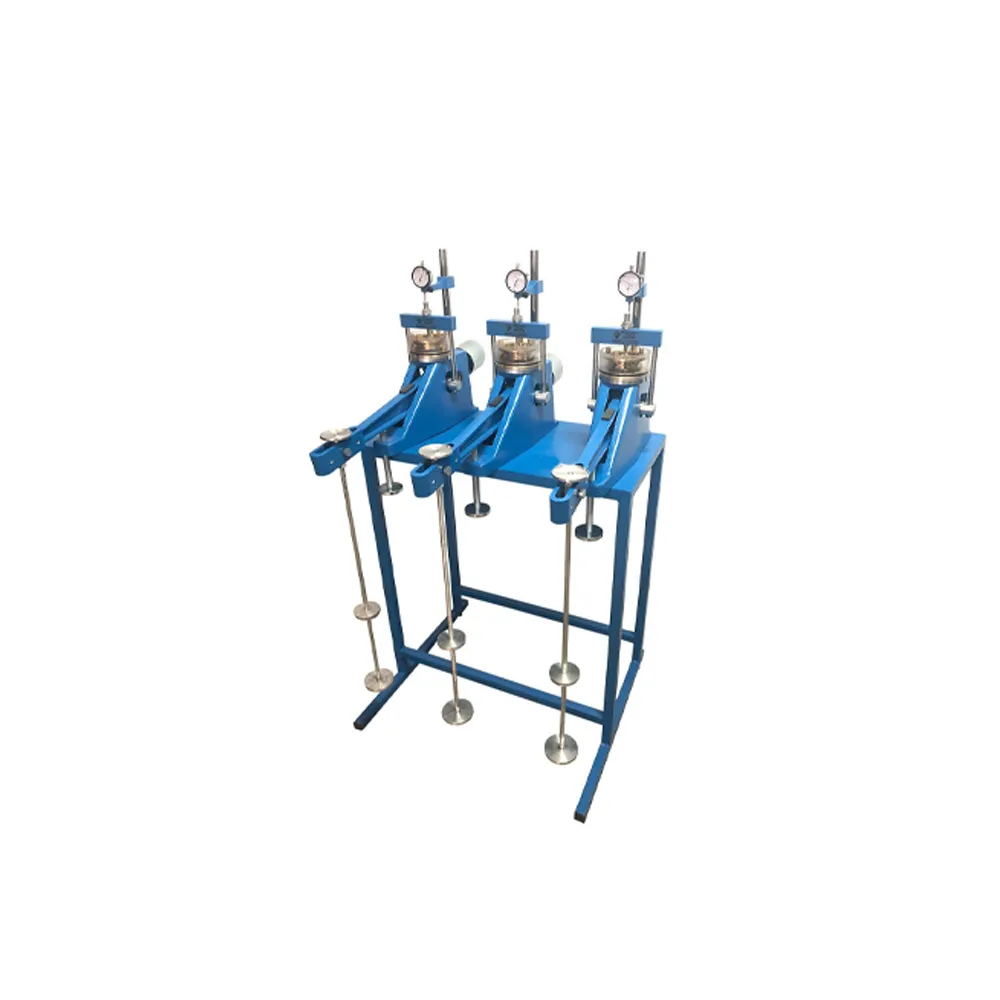
The apparatus holds a thin clay specimen in a confining ring between porous stones that allow water drainage. As each load increment is applied, the specimen compresses and expels pore water. By monitoring deformation at regular time intervals, geotechnical engineers calculate the coefficient of consolidation (cv), compression index (Cc), and pre-consolidation pressure — parameters essential for settlement magnitude and rate predictions.
Foundation Engineering Applications:
- Settlement prediction for buildings on soft clay deposits
- Pre-consolidation pressure determination to assess clay loading history
- Time-rate of settlement calculation for staged construction planning
- Embankment and earthfill settlement analysis for road and railway projects
- Land reclamation consolidation monitoring and prediction
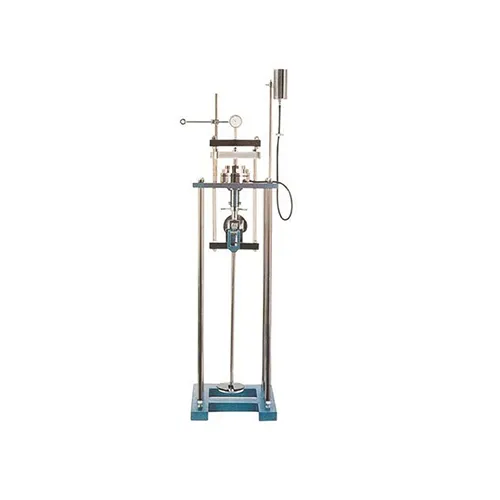
This single-gang apparatus includes a precision loading frame, dial gauge for deformation measurement, consolidation cell with porous stones, and trimming tools for specimen preparation. The rigid frame ensures axial loading without lateral deformation, while the sealed cell allows back-pressure saturation for improved accuracy with partially saturated specimens.