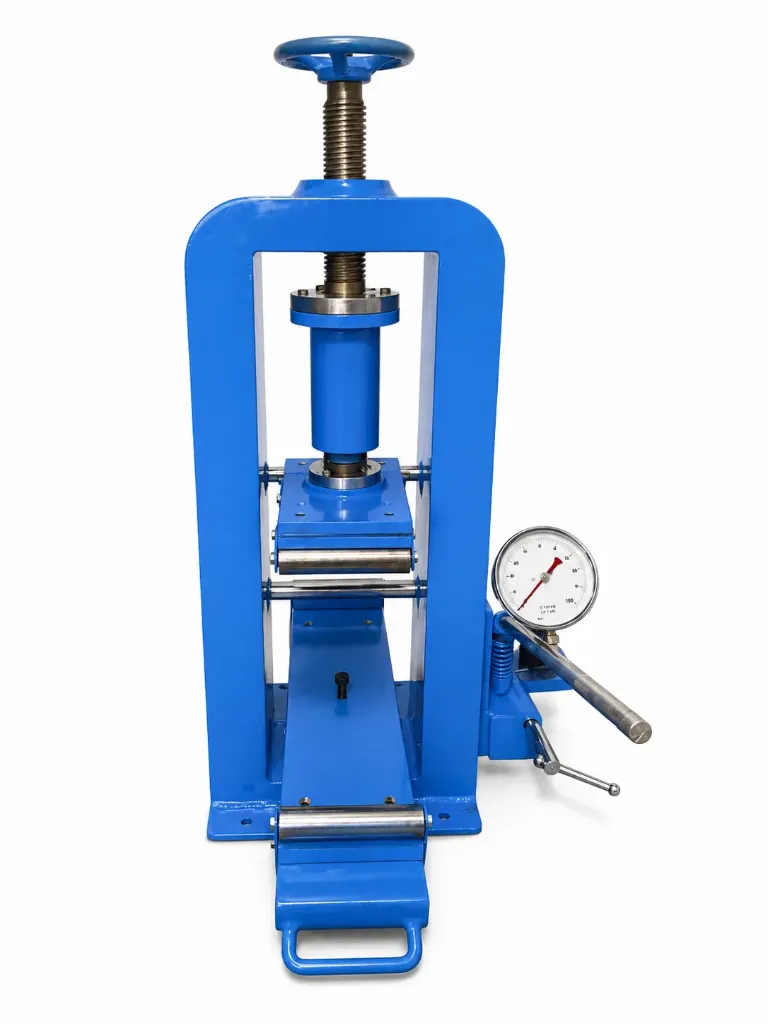
The Flexure Testing Machine determines the flexural strength (modulus of rupture) of concrete beam specimens — a critical parameter for pavement design, precast element quality control, and structural concrete evaluation. Unlike compressive strength testing which measures resistance to crushing forces, flexure testing reveals how concrete performs under bending loads similar to those experienced by slabs, pavements, and beam elements in actual structures.
Concrete's flexural strength typically ranges from 10-20% of its compressive strength, but this relationship varies with mix design, curing conditions, and aggregate characteristics. Pavement thickness design depends heavily on accurate flexural strength data because road slabs experience primarily bending stresses from wheel loads rather than direct compression. Using compressive strength alone for pavement design leads to either over-designed (wasteful) or under-designed (failure-prone) structures.
This machine applies center-point or third-point loading to standard concrete beam specimens (typically 100mm × 100mm × 500mm) through a rigid load frame and top-mounted hydraulic piston. The uniform load distribution ensures the specimen experiences pure bending in the critical center span, with failure occurring when tensile stresses on the bottom fiber exceed the concrete's tensile capacity.
Quality Control Applications:
- Flexural strength testing for rigid pavement and airfield construction projects
- Quality assurance of precast concrete beams, lintels, and structural elements
- Research and development of fiber-reinforced concrete mixes
- Acceptance testing of ready-mix concrete for flatwork applications
- Durability assessment of concrete exposed to freeze-thaw cycling
Available in manual and digital configurations with load capacities from 50 kN to 200 kN. The digital model features automatic modulus of rupture calculation and data logging, while the manual version offers simple, reliable operation with dial gauge load indication. Both models ensure accurate third-point loading geometry per IS 516 and ASTM C78 requirements.