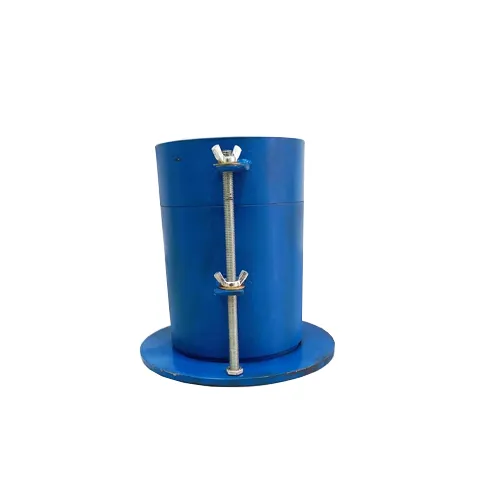
The California Bearing Ratio mould is the cornerstone apparatus for evaluating the load-bearing strength of subgrade soils, sub-base materials, and pavement layers in highway and airport construction. This precision-engineered mild steel cylinder (150mm internal diameter × 175mm height) creates standardized soil specimens that undergo penetration testing to determine CBR values — the critical parameter that dictates pavement thickness design and material suitability for roads carrying heavy traffic loads.
Every kilometer of highway construction depends on accurate CBR testing. Underestimate the CBR value, and you risk premature pavement failure, rutting, and costly reconstruction. Overestimate it, and you waste resources on unnecessarily thick pavement sections. This mould ensures your CBR specimens meet exact dimensional tolerances specified in IS 2720 Part 16, eliminating volume variations that could skew test results and lead to incorrect pavement designs.
The detachable collar and base plate facilitate controlled soil compaction in standardized layers using a rammer, while the precision-machined internal surface prevents specimen adhesion during extraction. After soaking and swelling measurement, the prepared specimen undergoes penetration testing to determine its resistance to deformation under load — data that directly translates into safe, durable pavement structures.
Critical Testing Applications:
- Subgrade strength evaluation for flexible pavement design on highways and expressways
- Material acceptance testing for granular sub-base and WBM road layers
- Soil stabilization effectiveness verification for weak or expansive clay soils
- Airport runway and taxiway foundation strength assessment
- Railway track bed and embankment bearing capacity determination
Constructed from heavy-gauge mild steel with corrosion-resistant finish for long service life under repeated laboratory use. The standardized 2250cc volume allows precise dry density calculation. Compatible with standard CBR testing frames conforming to IS, ASTM, and BS specifications.